The Last Visit by Susan Davis Abello

Emerald Blog: The Last Visit

The Emerald Blog :: Writing Inspired by Ireland

Every summer, Bay Path University’s MFA program in Creative Nonfiction writing offers a weeklong Writing Seminar based in Dingle, a town nestled on the Atlantic coast on the western shore of County Kerry, Ireland. Each day throughout the week, Seminar Facilitator Suzanne Strempek Shea gives participants a prompt to encourage writers to investigate new ideas and topics in their writing. During August 2020, we’ll publish our Emerald Blogs to showcase the diverse work developed from responses to Suzanne’s prompts.


From Suzanne Strempek Shea

Susan Davis Abello MFA ’17 wrote “The Last Visit” during our very first Summer Writing Seminar in July 2015 on this prompt:

So Where Have You Been?
Even the moment you read this is a place you can’t revisit. Use all your senses to write about a place to which you can no longer return. *


The Last Visit

by Susan Davis Abello

The Last Visit by Susan Davis Abello
Illustration by Susan Davis Abello

Sometimes when you close a door, you say to yourself, I will never touch this knob again. Sometimes you just know. You know when cardboard boxes are packed with your belongings and your voice echoes through empty rooms of a house, that you won’t be back. You know when you take one last look around your dorm on your last day of senior year, you won’t be back. I might have known I would never see my sister or her house again when I pulled her front door shut behind me 10 years ago, but the thought was buried deep under my denial. The kind of denial you need to stay sane. The kind of denial that allows you to believe that you’ll be back.

“See you at Christmas!” is what I would have shouted over my shoulder on any normal summer visit to my sister’s house in far-away Chicago, but this was no normal visit.

I left without even saying goodbye to her beloved cat, Ricky, who must have searched everywhere for my sister after we took her to the hospital days before—searched the white kitchen with its rooster plates and collection of mismatched teacups, searched the bedroom with her medicine bottles spilling from the bedside table onto the carpeted floor, searched the bathroom where the wig and the walker and the bed pan were left abandoned. Abandoned just like Ricky, like my nieces and their father, like all of us. But maybe Ricky already knew what we didn’t know, or didn’t want to accept.

It was the last time I would ever step foot in my sister’s house, and I wish I had taken the time to look around, to take note of the home she had, with so much joy and love, created for her family. I forgot to ask her the name of the color of paint on her parlor walls or where she found that little rug in the powder room. I forgot to appreciate the way she organized her linen closet or to find out what she kept in those sweet hat boxes in the guest room, the ones with the lavender flowers that were tied shut with a wide grosgrain ribbon. I forgot to tell her how beautiful her garden was, with its deep blue hydrangea and fat orange roses that flanked the back-porch door. I didn’t mention that the bed I slept in was soft and the sheets were lovely and smooth, cool on my skin even in the heat of July nights.

Sleep didn’t come easy in her house that summer. It wasn’t because my sister hadn’t made her guest rooms welcoming. No, sleep eluded us because she cried out sometimes. Moans that carried with them the weight of loss. It was a sound that settled heavily into the air, making its way down the upstairs hall, slinking uninvited through open doors like the oppressive heat we tried to keep at bay. The night left us anxious and ashamed of how we couldn’t help her. The comfort of her rooms was eclipsed by the stabbing pain of our hearts breaking slowly as she struggled to stay with her family for one more day, one more night.

Beside her, in the dark, my brother-in-law must have propped her pillows and adjusted her morphine-soaked body on the memory-foam mattress that burned the skin off her back, buttocks, and calves. Around her was all the softness and beauty she had created, but none of us could feel it, see it, or smell it. She had become all there was in that house. Her pain, her every breath, her moans, the sight of her—so foreign except for her eyes, the lightest blue with a hint of green. In the kitchen, meals were reduced to whatever the neighbor left in the freezer. The table was a neglected space, devoid of fresh-picked flowers and the pointed elbows of family and friends.

When my stay was over, there were no farewells. There was only denial––the kind that let me have hope. Hope that the door I pulled shut might one day open again. The kind that let me convince myself if I didn’t say goodbye, maybe she wouldn’t go.

* This prompt was inspired by “Write From the Heart: Inspiration and Exercises for Women Who Want to Write” (Ten Speed Press, 2003) by Lesléa Newman.


About the Writer

Susan Davis Abello is an author, illustrator, and business owner who published her first children’s book, Pumpkin and Buster and The Right Thing to Do About a Bully (Tate Publishing) in December 2011. She particularly enjoys writing essays about family, life in New England, and her experiences working in South America (where she met her husband) after earning her undergraduate degree. Susan earned her MFA in Creative Nonfiction Writing from Bay Path University in 2016.


Write with us in Dingle next year, July 31 to Aug. 8, 2021. Contact sshea@baypath.edu for full information.

We welcome submissions to Multiplicity Blog (nonfiction prose of 1,000 words or fewer, poetry, and photography) all year. We also accept submissions of longer nonfiction works (up to 5,000 words), poetry or photography for the Fall 2020 issue of Multiplicity Magazine: At Work. Magazine submissions close on September 25, 2020. More details here.
Forgotten Desolation by Andy Castillo

Emerald Blog: Forgotten Desolation

The Emerald Blog :: Writing Inspired by Ireland

Every summer, Bay Path University’s MFA program in Creative Nonfiction writing offers a weeklong Writing Seminar based in Dingle, a town nestled on the Atlantic coast on the western shore of County Kerry, Ireland. Each day throughout the week, Seminar Facilitator Suzanne Strempek Shea gives participants a prompt to encourage writers to investigate new ideas and topics in their writing. During August 2020, we’ll publish our Emerald Blogs to showcase the diverse work developed from responses to Suzanne’s prompts.


From Suzanne Strempek Shea

Andy Castillo MFA ’19 wrote “Forgotten Desolation” during the 2017 Summer Writing Seminar on this prompt:

A Kindness:
The whirl of life frequently places us at the mercy of strangers. Write about the last time someone came from out of the blue to make a difference in your story, or that of a character’s.

I see in Andy’s piece the kindness of a stranger’s sharing of time and insight, and in the promise the writer makes to tell others what he learned that day—a promise Andy keeps here.


Forgotten Desolation

by Andy Castillo

Forgotten Desolation by Andy Castillo

Heavy is the ground that carries lost souls.

Heavier still, the voice of a man whose family is buried there.

I met him walking up Cairn Hill above Dingle in western Ireland. He’s smoking a cigarette and standing beside a small coupe on a dirt road lined with low-slung pastel houses with chipped paint and wildflowers growing in their front yards.

“Do you know where the famine graveyard is?” I ask.

“Just up the hill,” he grunts, his scratchy voice dripping Ireland. “Follow the road along about five minutes. Can’t miss it.”

I turn to go. “I’ll join you,” he says. “Heading that way myself.” He stamps out the cigarette.

We fall into step, boots crunching gravel, and talk about the weather and work. He’s a Dublin schoolteacher who grew up on the Dingle Peninsula. I don’t ask his name; he doesn’t offer it.

The road narrows, hemmed in by rough stone walls; grass runs down the middle. Green pasture sectioned with hedges and guarded by barking farm dogs rises into gathering dusk. Dingle lies behind us, a coastal city with a bar featuring live music and Guinness on every street corner.

Ahead, sheep graze as far as the eye can see. Crows squawk at us as black clouds roll in from the west.

“This has changed dramatically from when I was a young lad,” the man says, sweeping a hand back toward Dingle. “Town was incredibly quiet. No tourists. No restaurants.”

“Sounds idyllic,” I say.

Even now, despite the tourists, it’s a fairytale place. Red fuchsia wildflowers line Slea Head Drive, the narrow coastal road that winds around Dingle Peninsula. Towering cliffs drop sharply to the ocean far below. Quaint farmhouses and prehistoric ruins overlook endless blue sea, and sheep and cattle range across it all.

Modern Dingle is a picturesque snapshot of past rural life—but it doesn’t capture everything.

Famine ravaged Ireland between 1845 and 1852. One million people died in eight years; the country’s population dropped almost 25 percent. The cause of the tragedy: Phytophthora infestans, the microorganism responsible for the potato blight that destroyed the staple crop one-third of Ireland’s people depended on to survive.

“Desolation,” the man says, pausing in the road, his tone suddenly bitter. The gravel stops crunching.

“We had no control over our destiny. We were ruled from Britain and didn’t have any rights. The people who survived the famine went to America.”

Members of both our families were among those survivors. Mine sought a better life in South Boston, not far from where I grew up in Northampton, Massachusetts. The emigrants from his settled in Hartford, Connecticut.

We lean into the wind, trudging up Cairn Hill. There are no tourists here.

At the top, an iron gate blocks our way into a small stonewall cemetery.

Far below, Dingle’s lights twinkle on. Boats drift at anchor in the bay. Night has come. The man points over the city to a tower barely visible on a distant hill. It’s a famine relief tower he says, built by starving people. Across the bay is another, Hussey’s Folly, a solid structure that looks like it’s from the middle ages.

“If you didn’t work, you didn’t get fed. A lot of people died working like that. They would crawl to those places.”

We enter the cemetery through the creaking gate.

Boney hands gripping dirt, crawling up the hill; mothers screaming, clutching dead children to their chest beside a square yellow building near the burial ground. Hundreds of people crammed inside, rotting.

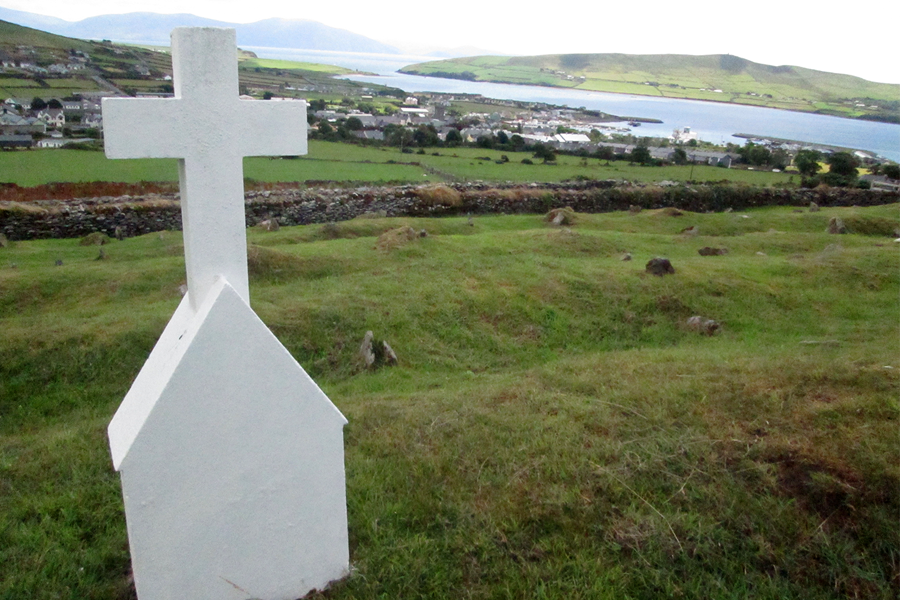
In my mind, I see them as clearly as I see the white, wind-tossed barley surrounding the dozens of unmarked graves, the chipped black stones sticking up from the cemetery’s uneven ground, the lone white cross in its middle. My feet sink into the soil. If I stayed, I fear I’d become a stone.

“Leaders believed the famine was God’s fate,” the man says, his voice now thick with emotion. I can’t see his tears, but I know they’re there. I can feel them drop like stones into the bay. His ancestors lie here.

“About 3,000 people were buried here in four years,” he says. “There were a lot of open graves. There might have been 20 people buried in one.”

He turns toward Dingle. “You ask the youth of society—they don’t know anything about it. We’ve collectively forgotten. Dingle’s a tourist town. The people there aren’t locals. The locals are gone.”

We stand silent in the gloom. A mist floats across distant hills and black clouds suffocate the sky. Rain comes, watering the graves, a cistern emptied out of inky blackness.

I ask what I can do.

“Best thing you can do is come back here tomorrow. Bring someone. Sit down here,” he says, pointing to a bench. Then he walks away, hitting black stones with a strand of barley as he goes.

“I’ll write about it,” I call after him.

“You do that,” he says without looking back. His gait is weary. I sit on the bench, watching him go until he’s just a speck moving down Cairn Hill toward Dingle’s blinking lights.


About the Writer

Andy Castillo is the features editor of the Greenfield Recorder newspaper (Greenfield, MA). He is an experienced editor who has worked for several publications in western Massachusetts and as a staff writer for GoNOMAD.com Travel. He holds a Master’s degree in creative nonfiction from Bay Path University and can be reached at andychristianart@gmail.com.


Write with us in Dingle next year, July 31 to Aug. 8, 2021. Contact sshea@baypath.edu for full information.

We welcome submissions to Multiplicity Blog (nonfiction prose of 1,000 words or fewer, poetry, and photography) all year. We also accept submissions of longer nonfiction works (up to 5,000 words), poetry or photography for the Fall 2020 issue of Multiplicity Magazine: At Work. Magazine submissions close on September 25, 2020. More details here.
Down Brandon by Clifton "Jerry" Noble

Emerald Blog: Down Brandon

The Emerald Blog :: Writing Inspired by Ireland

Every summer, Bay Path University’s MFA program in Creative Nonfiction writing offers a weeklong Writing Seminar based in Dingle, a town nestled on the Atlantic coast on the western shore of County Kerry, Ireland.

Each day throughout the week, Seminar Facilitator Suzanne Strempek Shea gives participants a prompt to encourage writers to investigate new ideas and topics in their writing. During August 2020, we’ll publish our Emerald Blogs to showcase the diverse work developed from responses to Suzanne’s prompts.


Down Brandon

Words & Music by Clifton “Jerry” Noble

Down Brandon was begun on the first night of our first Ireland writing seminar in July 2017.  The town of Dingle was shrouded in gray clouds and sheets of rain. The turbulence of the storm sweeping down the slope of Mount Brandon (seen from the safety of our guest-house window) slipped easily into words and music. As the week went on, new experiences and memories made in Brandon’s shadow added themselves to the ballad.

The finished song was performed for the first time at the seminar’s final group reading session at An Díseart Centre of Irish Spirituality and Culture—thanks in large part to the generosity of Mazz O’Flaherty, proprietor of the Dingle Record Shop, smallest record store in Ireland, who let me borrow her guitar for the evening.


Down Brandon Lyrics:

The wind blows cold down Brandon
The trees bow their heads to the mountain’s shoulder.
The rain slips in like a thief in the night
And the mist folds ‘round ev’ry byre and boulder.

My dear and I lie safe and warm
Though the wrath of the Gods howl o’er us.
We’re sheltered safe in Dingle Bay
With the best of life before us.

The wind blows sharp down Brandon
The calves and the lambs turn their tails in defiance.
The fishermen pray for a calmer day
And the home-fires smoke in leeward silence.

My dear and I watch the lowering sky
And remember the trials we’ve lived through.
For now we’ll stay here in Dingle Bay
And draw warmth from the words, “I love you.”

The wind blows soft down Brandon
It ruffles the fuchsia the hedge encloses.
The clouds have lifted, a holy gift,
And the sun caresses the pale beach roses.

My dear and I take it all in stride
As we stroll toward the distant islands.
With Dingle Bay sparkling on our way,
Wishing Ireland could be our land.

The wind is calm down Brandon
The mist of mem’ry falls fast upon us.
We hold on tight to each precious sight;
Though dimmed by time, they will ever haunt us.

My dear and I heave a mournful sigh
For our time in Dingle is nearly o’er.
We’ll find a way to return, some day
To our paradise on the Kerry shore
Where the wind blows sweet down Brandon.


About the Composer

Clifton “Jerry” Noble, is a composer, arranger, performing musician, and music critic who works in musical genres ranging from art music to rock n’ roll. His work has been performed throughout the United States and in international venues from London to Jerusalem to Kolkata. He serves as the Staff Accompanist for the Smith College Music Department.


Write with us in Dingle next year, July 31 to Aug. 8, 2021. Contact sshea@baypath.edu for full information.

We welcome submissions to Multiplicity Blog (nonfiction prose of 1,000 words or fewer, poetry, and photography) all year. We also accept submissions of longer nonfiction works (up to 5,000 words), poetry or photography for the Fall 2020 issue of Multiplicity Magazine: At Work. Magazine submissions close on September 25, 2020. More details here.

Miss Eliza by Suraj Alva

Miss Eliza

By Suraj Alva

Mumbai, India, 1998

All the boys in my class thought Miss Eliza beautiful and mysterious. Like an American film actress, she had pale skin and wore skirts or jeans. The other teachers wore saris or dresses more concealing than the nun headmistress’s black blankets. Miss Eliza was also kindhearted. Before going home, she gave everyone a hug.

Except me.

When David turned nine, she gave him a big kiss on the cheek. Luckily, he was my desk-mate. I kicked him to stop him from smiling so stupidly.  I was turning nine in two months and I wanted Miss Eliza to kiss me. I was in love.

But she never touched me or even smiled at me.

“You talk funny in English. Maybe that’s why.” David said.

“What you meaning?” I asked.

“You say yum not M, yes not S, yun not N….”

“Shut up.”

“I’m only helping.”

Instruction was in English at the private Christian school I attended. I had moved to Mumbai from Kuwait only six months before, and the Kuwaiti Indian community where I grew up came from the southern part of India, so I spoke English with a thick South Indian accent.

Maybe that was why Miss Eliza didn’t like me.

But where could I learn proper English? Except in school, everyone in Mumbai spoke Hindi or Marathi. I turned on the TV to the Cartoon Network, the only channel that used proper English. For a month, I imitated how the cartoons spoke, but Miss Eliza treated me the same.

Priya, one of the class’s slum-kids, said, “Miss Eliza thinks you’re hoity-toity.”

“Who says?” I asked.

“I’m not a tattletale,” she said.

“David? Michael? Joshua? Jessica? At least tell me what they are saying,” I begged.

“They say he acts big, coming from Foreign, his abu working in Foreign,” she replied.

None of the other kids or their parents had gone abroad. Growing up outside of India in the oil-rich Persian Gulf made me feel special. My daddy still worked there, sending money to Mummy so she could take care of our new home. It was why we had the only air conditioner and CD player in our building. But if Miss Eliza didn’t love me because I was a spoiled, selfish boy, I would show her I wasn’t one.

Mummy told me my teacher was a widow with two children, but Miss Eliza often brought food for the class’s two slum kids. I started giving the lunches Mummy made me to those kids, hoping Miss Eliza would notice. Now she didn’t have to give them food. She could save her money. Like in Hindi films, I was her hero. She would have to fall in love with me.

One day, Mummy came to school with my inhaler. I was sitting in the eating room with my back to the door. She saw me giving my food away.

Furious, she dragged me to the headmistress’s office. Miss Eliza was called in.

“Do you see what he is doing?” Mummy asked her.

“I am not sure,” Miss Eliza replied.

“How come? You are his teacher.”

“In class, he….”

“No. At lunch. Do you know he is not eating?”

“Why not?”

“You are making him give his food to the slum children. I pay for my children—and all the money I gave as a donation.”

“I didn’t know,” my teacher said.

The headmistress silenced Miss Eliza with her palm and said, “Madam, we are really sorry.”

“What did I tell you for my children?” Mummy asked.

“We are taking special care of them, like you asked,” said the headmistress.

“Maybe I will take them out.”

“No need, madam. We will all keep a special eye on him.”

I kept my head down, embarrassed, not saying a word. I was ashamed and avoided Miss Eliza’s eyes. I didn’t save her. I put her in trouble. I was no hero—only a stupid, silly boy. Gone was all hope for my first kiss. Now I knew Mummy’s bossiness was why Miss Eliza treated me like I belonged in a glass cage.

Three days before my birthday, after a week of heavy rains, the sun visited and all came out to see it—snails, earthworms, birds. Our class took a field trip to the sea. The water was too filthy for us to swim in, so I made a sand tower on the beach while my classmates threw rocks at seagulls.

I felt something slide on my leg. When I turned to look, it was a snake! It hissed at me and I screamed. I had grown used to how dogs, cows, goats, monkeys, buffalo, and elephants lived like humans in Mumbai, but I had never seen a snake.

I cried and called for my daddy. I wanted him to take me back to Kuwait—away from the animals, the stinking smell, the beggars, the dirtiness, the chaos of Mumbai.

Miss Eliza took me in her arms and held me. I could feel the warmth of her belly on my cheek and smell her flowery perfume. She told me not to be scared, that everything was okay. Sobbing, I turned to see my classmates circle the snake, throwing rocks to kill it. It was a game and they were having fun. I buried my face in Miss Eliza’s blouse and cried some more. She held me tighter and my fear gave way.

When my birthday came, Miss Eliza left the room during my birthday song. I kept looking at the door, waiting for her. I blew out the candles, wishing. When I looked up, she stood in the doorway. She came and gave me a big sloppy cheek-kiss, patted my head and left again.

In 2001, my family and I moved to the Persian Gulf again. By then I was hitting puberty hard, but I was in a place where gender segregation was law. I went four years without meeting a girl.

When I turned 16, I moved to California. I was shy and abashed around women. My first real kiss came two years later.

I still think of Miss Eliza now, at 30 and determined to get married, but not sure how to go about it.


About the Writer:
Suraj Alva
began freelance writing in 2017, and his work has appeared in GNU Journal, The Fiction Pool and elsewhere. His essay “Nothing More Human,” published in The Common in April 2020, convinced an agent he has what it takes to write a publishable novel. He is headed to Purdue University’s MFA program to start that novel this fall.

With Bells on My Boots: A Disabled Woman's Relationship with Style and Beauty by Dana Robbins

With Bells on My Boots

With Bells on My Boots
A Disabled Woman’s Relationship with Style and Beauty

By Dana Robbins

I was 23 when I had the stroke. It paralyzed my left side and left me mourning the breezy, beautiful young woman I had been. Even after several years of intensive physical therapy, my left foot pronated and dragged. My left arm sometimes froze with a bend at the elbow. With the left side of my face paralyzed, my smile is still slightly askew.

As a young girl and throughout my early twenties, people commented on how pretty I was with my long dark hair, porcelain skin, large green eyes and petite hourglass figure. In my family, the women were expected to be beautiful. My grandmother, an old school Russian beauty, told us that a man only need be one step above a monkey but a woman must be beautiful. Beauty defined my self-worth. After the stroke, people looked at me with pity and shock. I felt deep shame seeing myself in a mirror.

A few days before the stroke, I was in an Upper East Side boutique looking at a beautiful pair of green slingback shoes. They were costly, so I passed on them. Being only five foot two, I loved the lift and line a good pair of heels could give me. As a young professional, I felt more polished in heels. I remembered the slingbacks as I lay in my hospital bed. Life is short. I shouldn’t have denied myself. When I told my mother the story, she left my bedside and returned with the shoes. I rolled right out of the left shoe. I’d never wear high heels again.

Shoes are a complicated proposition. I need a built-up, wide-footbed shoe with strong support for my left ankle. I also wear orthotics. As a child in the sixties, I was forced to wear heavy shoes that were supposedly good for the development of my feet. I hated the heavy clomp-clomp when I walked. After the stroke, I felt like those dreaded shoes returned to torment me. I spent years in denial, buying heels and fancy shoes I couldn’t wear. Like Cinderella, I believed that finding the magic shoes would make me whole. After developing pain in my left knee from my gait in my fifties. I was forced to become more realistic.

After my stroke, I had to relearn getting dressed, how to ease my paralyzed arm into a sleeve first and putting on my bra over my head. Shirts and jackets slide down my left shoulder. Décolletage, or even a normal open neck, slips off and I look disheveled. Zippers on jackets are impossible with one hand. I can’t tie my shoes or buckle a belt. I need Velcro or buttons, but neither hold well.  I can’t get my left hand into a glove or mitten. During winter, I wear fingerless gloves. They’re easier to put on, but not warm.

Wearing pantyhose is another ordeal. Years ago, working as a lawyer, I wore skirted suits with stockings nearly every day, resulting in piles of ripped pantyhose. Struggling to pull them up, I’d pull too hard, and another pair would bite the dust. Now that I’m in my sixties and retired, nobody would blame me if I only wore sweatpants and sneakers. I’m just not ready to surrender beauty.

Long ago, I promised myself that if people are going to stare at me, I will be wearing the nicest clothing. Fortunately, designers are becoming aware of fashion needs for disabled women, featuring clothing easier to get into. The Cerebral Palsy Foundation even sponsors a design for a disability fashion show. “Shop until you drop” is a reality for me because trying on clothes is tiring and I break into a sweat inside the dressing room. If I don’t have anybody with me, I gravitate to small stores where the staff is helpful.

Grooming is taxing. Since I can’t cut or file my nails, I get regular manicures. If my left hand isn’t carefully positioned palm down, my thumb pulls inward and my hand involuntarily forms a fist, smudging the polish. Often, a manicurist who doesn’t understand grabs my hand off the table and says “relax.” My hand does the opposite, curling like a starfish poked with a stick, frustrating both of us.

I can’t do much to style my hair. Most hairdryers require two hands, one for the dryer, one for the brush. I keep my hair medium short and my excellent hairdresser cuts to my natural wave. All I do is shampoo it. My husband would love for my hair to be longer but I wouldn’t be able to put it up on a hot day.

In our society, disability is shameful and maintaining my appearance is important for my self-esteem. In this, my role model and inspiration is disabled artist, Frida Kahlo. Her iconic style, derived from traditional Mexican garb, was not only an expression of ethnic pride but a way of working around her disability. It wouldn’t be fair to say she “concealed” it. Many of her paintings depict her naked. To disguise the unevenness of her legs caused by childhood polio, Kahlo designed red suede boots with a built-up platform. After a bus accident damaged her spine and pelvis, she underwent multiple surgeries. She then had to wear steel corsets. Her long full skirts covered her withered leg. Loose blouses and ruanas flowed over the corsets. Her elaborate jewelry and coiffure drew attention upward to her striking face.

Many years after her death, Kahlo’s unique style is admired worldwide and is enshrined in the Frida Kahlo House Museum in Mexico City. There, I once stood before an embroidered red suede boot, which she once wore on her right foot. The most captivating details were the two small jingle bells fastened to the laces. Instead of the uneven clomp-clomp, there was the pleasing sound of bells.

Kahlo said, “Viva la Vida. Live Life.” Like Frida Kahlo, whatever my physical limitations, I will dress in beautiful outfits, and metaphorically, will have bells on my boots.


About the Writer:
After a long career as a lawyer, Dana Robbins earned an MFA in creative writing from the Stonecoast program at the University of Southern Maine. She is the author of two published books of poetry, The Left Side of My Life and After the Parade (both published by Moon Pie Press, Maine ). Her poems and essays have appeared in numerous publications.

.

Multitude of Array by Shiela Scott

Multitudes of Array

By Shiela Scott

From the Photographer:

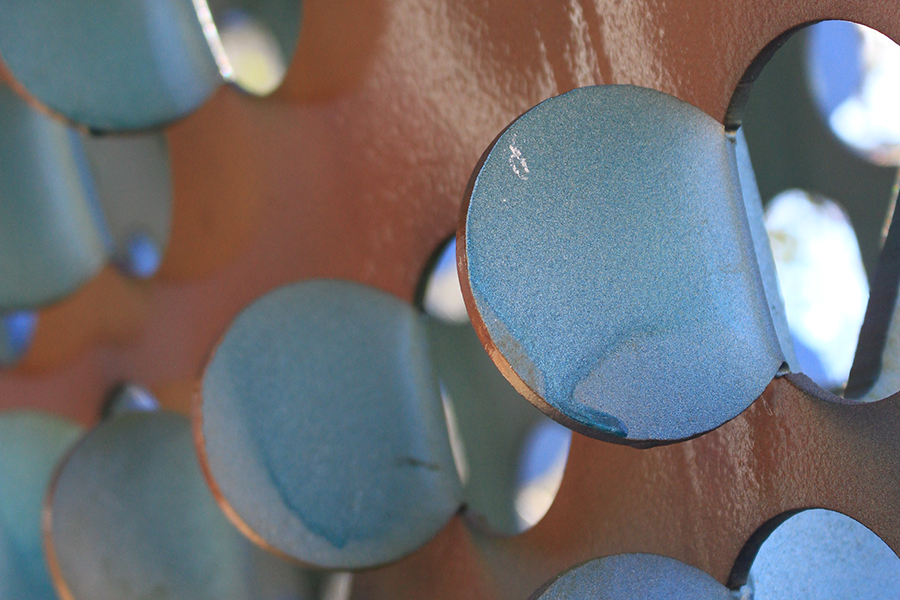
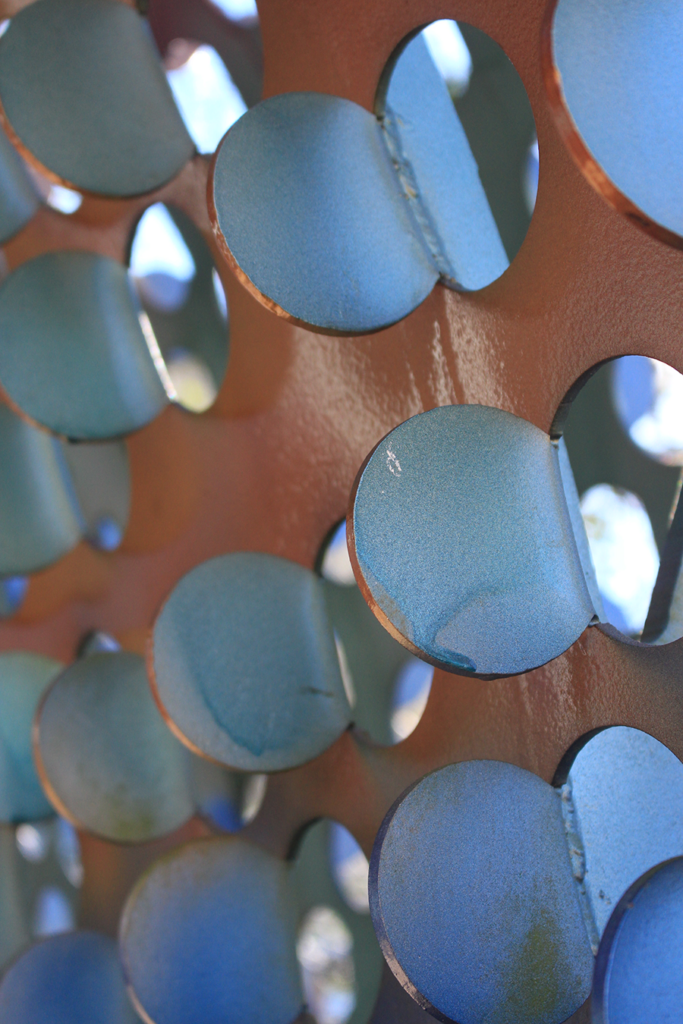
Multitudes of Array was taken in front of the Mississippi Museum of Art in downtown Jackson, Mississippi. It shows part of a steel trellis incorporated into an artistic landscape piece that invited me into the garden of beautiful flowers near the museum’s entrance. I wanted to accept and capture the garden’s invitation in a photograph.

I am inspired by many photographic styles; no one photographer keeps me in awe. My love of photographing in natural light made me gravitate to this piece. Amazed and captivated by so many directions of shine, I wanted to capture what my soul felt when I observed these folds and curves of metal. I hope this piece will glow and light the imagination and pleasure of all its viewers


Multitude of Array by Shiela Scott

Multitudes of Array


About the Photographer:
Shiela Scott
is a photographer, creative writer and business entrepreneur. She earned her BFA in Creative Writing for Entertainment from Full Sail University and her A.A.S in Digital Photography from Antonelli College. Her poetry  has appeared in Ponder Savant and multiple other venues. Follow her on Twitter @ShielaDenise.

Wasp Questions by Benjamin Thomsett

Wasp Questions

By Benjamin Thomsett

The decapitated wasp head still bit and chewed at anything in front of its face. Meanwhile, a little further away on the windowsill, the body arched and the tiny black-needle stinger jabbed and jabbed. I watched the two separate parts do this for 20 minutes, sometimes prodding and leaning in close for a better look. Was the wasp alive or were the spasms of post-death the angry feelings of a yellow and black soul? Was there a difference?

As an eight-year-old I couldn’t work it out. I still can’t, come to think of it. I guess I could look it up now, but I don’t think it’ll change the perspective I have of cruelty and death, or the historical religious ideology that grew with that warped little boy. Memories can’t remake themselves, and I don’t care what a Nobel prize-winner tells me after being locked in a laboratory for 10 years. Lab chemicals and a lack of natural light can do strange things to a mind. So can academic isolation.

As an eight-year-old I tested things for myself: “O Lord, receive this wasp…. Shit, is it dead yet? Send me a sign.” Nothing.

A poll on the UK news yesterday showed that a little less than three quarters of the Christians polled believed in the resurrection of Jesus following his crucifixion. Just over half of them said they believed in Heaven/Hell/some form of afterlife.  Is that important? I don’t know. And I doubt you do either.

There’s only one way of finding out and we’ll all get our answer to that particular sticky question in the end—heart attack, eaten by a bear, it doesn’t matter how you get there, just be assured you will eventually see the truth, even if it’s just the light fading and the voices getting distant. One thing is certain: you’ll never be able to share the answer with the rest of us back here scrabbling in the human filth of war, enforced poverty, and a vicious pandemic. It’s hard to hear spiritual whispers from beyond the grave when you’re choking.

Just as well. Questions are okay, but only if you are ready for the answers.

There must have been 10 wasps on the windowsill that summer. They all died terribly, jabbing and twisting, little legs circling. Some of them took a long time to stop moving, the stinger last of all. Victims of me and a cheap copy of a Swiss Army penknife. No anger or revenge. Just cold concentration.

It felt good to be in charge for once.


About the Writer:
Benjamin Thomsett
is a parent, partner, and hot noodle hater. He lives in North Lincolnshire, UK, where the air is clear and the birds sing loudly. In his spare time, he worries about most things.

What It Takes to Survive by Christine Richardson

What It Takes to Survive

By Christine Richardson

I stepped through the frigid northern Minnesota darkness toward my sleeping dog team, careful not to rouse the eight dogs tucked under warm piles of frost-coated arctic sleeping bags in front of the dogsled they had pulled 80 miles. We were at a rest stop in a 120-mile race on the north shore of Lake Superior. 

Bending over the alcohol stove, I heard shuffling. It was Dory, my seven-year-old lead dog. She stood up. Her sleeping bag slipped off.

“We’re not leaving for an hour,” I whispered.

She blinked and stood quietly, observing me.

“Please lay down,” I implored.

Dory had calm focus in her light brown eyes. If I was up, she was determined to be up too.

Switching off my headlamp, I knelt in the darkness and draped my arms around her neck. It was -20F—killing temperature—but Dory was warm under her arctic coat.

The moon was full and the wolves on the trail had stayed away from the racing dog teams. Neither the cold nor the wolves would be problematic as long as the lead dog kept a steady pace. Looking at Dory I knew all would be well. She loved racing. A few years ago, on a cold, starless night in northern Maine, she led our team and out-ran a lone wolf after the meat snacks in the dogsled. She was always all in, despite the danger.

“We’ve got this, wolves be damned,” I whispered to Dory, knowing I couldn’t do it without her.

Truthfully, I would never have had the confidence to participate in that race, less than a year after my battle with breast cancer had left me weak and bald, if Dory hadn’t been leading. From the minute the veterinarian delivered her by C-section and placed her soft newborn body into my arms, I knew we were important to each other.

At age two, she graduated from being a playful puppy, running in the back of the dog team where I could see her shenanigans, to a full-fledged lead dog.

“Wanna lead for a while?” I asked Dory only 30 miles into her first 250-mile race, when my old pro, Glock, lost interest in going forward.

Bouncing in her harness, Dory dragged me to the front of the team, where I clipped her into the top spot. She had been waiting for this. Dory led the remaining 220 miles to the finish line. From then on, she led every race we ran together until she retired a few months ago.

Upon returning home to New Hampshire from our last race this year, in early March, everything became eerily quiet. The whole world was still, hoping that the prolonged silence of lockdown was the only thing COVID would force us to endure.

By mid-April, I was jobless. My partner, Kip, would soon be too. My sister-in-law in New York City was just out of the hospital after major heart surgery, and my step-father was determined to continue working at a local senior home in spite of his and my mother’s ongoing health problems. I couldn’t visit anyone.

As my options disappeared, my fear heightened. This was an uncharted trail and I wasn’t sure where the wolves were hiding.

Keeping busy held my panic at bay. I found solace in making maple syrup from the trees on my land. The physical work of hauling sap was rewarded by long hours of staring into the fire under the boiling sap pans while contemplating life. I remembered that cold night in Minnesota vividly. Dory had led the dogsled team into the moonlight, over 55 miles through The Caribou Hills to the finish line with ease and confidence. The struggle to get there felt like a dream. I had been overwhelmed by cancer for so long, but that day, Dory had made anything seem possible again.

Suddenly, I was jarred from my thoughts.  Kip was shouting from the deck.

“Christine, come now!”

It was his there is a dog emergency voice. I ran.

Dory was bloating. Without immediate treatment, the air gathering in her stomach would kill her. I rushed her to the emergency vet where a masked and gloved tech took her from me and told me to stay in my truck. Sitting in the parking lot, looking through the vet’s huge glass window, I hoped to get a glimpse through an open door of busy technicians working furiously on Dory.

Fifteen anxious minutes later, the veterinarian called.  Dory needed surgery—now. I choked when I heard the estimated cost was between $7500 and $9000 and wailed that I did not have that much, even on my credit card.

“Let me call you back,” I begged.

“Ok, but hurry,” she replied. “In the meantime, we’ll put together a quote.”

Sobbing, I called Kip. “What do I do? It’s Dory!”

“I know.” He tried to calm me, but he was as shaken as I was.

“If we have to put her to sleep, I can’t even be with her!” I was hyperventilating, barely able to speak.  

Then my phone beeped, it was the vet again.

“If there are no complications, it will only cost $5000,” she said.

“DO IT!” I yelled.  I had no job but precisely $5000 in credit. I gave her my card number and then called Kip to tell him the “good news.”

I was tremendously relieved when Dory pulled through. The next day, I was allowed to bring her home. She healed well with only an eight-inch scar on her belly, a reminder of how close I came to losing her. My finances are even more limited now, but I have no regrets. Money doesn’t live, breathe, or outrun wolves.  Letting Dory go would have been unbearable.

Sometimes, when Dory is sprawled on the couch with her legs in the air, I run my finger gently along her scar. Before long, tears escape my eyes. Sensing my mood, Dory rolls over, licks my hand. I can’t predict the future, but I’m grateful that Dory and I will both be here to greet it.


About the Writer:
Christine Richardson
lives on a farm in Canaan, New Hampshire with her partner Kip and 16 sled dogs. She has an MS in Cell Biology, but left her 18-year career in science to pursue an MFA in Creative Nonfiction at Bay Path University and to work on her memoir and practice shamanism. She describes herself as an outdoor adventurer, retired scientist, dog musher, cancer survivor, wisdom keeper and writer. . .but most of all, a dog lover.

The Right Hand of the Father by Reverie Koniecki

The Right Hand of the Father

By Reverie Koniecki

When I was still young enough to believe I could become president someday, but old enough to watch my little brother occasionally, my family went to two different Baptist churches. On weekends when my mother didn’t have to work, we went to a church where the congregation looked like us. The preacher went in and out of song when he felt moved, and the choir responded to his lead the same way a baby mirrors its mother. Women in white dresses and gloves monitored the congregation for those who lost control of their bodies to the spirit. The spirit scared me. I didn’t want some other entity coming into my body. The women in white pulled seizing bodies into the aisle and made sure the invaded didn’t accidentally knock their heads into the pews or kick their skirts up for everyone to see their unmentionables. Church ended when the preacher finished preaching. If the spirit moved him, we’d let out at 2:30.

On the weekends when my mother did have to work, we went to another church where we sang quietly from hymnals to music played at a respectable volume. Most kids left their parents to go to the nursery. The ones who stayed said soft “Amens” that curved around their tongues at the right pauses in the monotone sermon. No one yelled. There were no ladies in white. The pastor stayed on schedule and the service ended promptly at noon.

When we couldn’t go to church, we prayed to Reverend David Paul on The Miracle Hour TV show.  We praised God when he stepped onto the stage. David Paul put his hands on heads. He took donations. You could call an 800 number or mail him a check. He went on tour and spread his miracles from city to city. Heads bowed for him when he asked people to believe. When he said to have faith, we had faith. I believed in the power of David Paul the way I believe that I sit at the right hand of my Father.

When my mother became a Mormon, she sicced the missionaries on me. I argued with them about the three tiers of heaven they tried to convince me existed. I can’t remember the requirements for the top two tiers, but I figured I could probably make it to the lowest one. I just wouldn’t be able to travel up to visit my better-behaved loved ones. I was suspicious about that sort of segregation. It seemed unjust to me, especially compared to more the cut-and-dried concepts of heaven and hell. How do you divide degrees of goodness? I thought if I could just be good, then good things would come my way.

We learned about confessing sin in Sunday School, yet my sins still have kinetic potential. And I can’t confess the sins of my father, whose parting silhouette is my childhood tragedy.

Growing up, my mother constantly reminded me she was the parent who stayed. I resented her because other kids with divorced parents got to choose one, but I was stuck with her. I gave her Father’s Day cards and told her she was a better father than the one I couldn’t remember. When my friends complained about getting grounded, I said, “At least you have a father.” I imagined running into him on the street. I searched the faces of strangers for my likeness.

People consoled me with accusations. “Your father’s a jerk.” “Your father’s an asshole.” “Your father up and left you.” I didn’t understand they were taking my side. All I knew was that this man, this myth, was part of me. When someone asked about my father, I’d say I didn’t have one. As I got older, I repeated phrases I had heard about him and knew too well. I grew to hate him. I denied him. I loved him.

David Paul came to Hartford. We went to see him because we were hungry for a miracle. He yelled on the pulpit. My skin grew into rugged terrain as each hair follicle stood to attention. He cured other people. People rose from wheelchairs. The blind could see. The sick became healthy. I tried to get David Paul’s attention. He never looked in my direction. I prayed because I believed. I believed because I prayed. David Paul didn’t put hands on me. He didn’t acknowledge my prayers.

After he left, my father and I didn’t speak again until I was 10. Then again at 24. And again at 32. Our conversations took the same arc each time we tried to have a relationship. First, we corralled the lost years between us and rediscovered that our memories were incompatible. He would go on and on about the past. About how he swindled my mother out of child support. About how he regretted his relationship with the woman he left my mother for, his sons’ mother. About the stupid canopy bed he bought me when I was four. Eventually we hit a wall where one of us offended the other and I dipped out.

He carries my fifth-grade picture in his wallet, the photograph preserved in yellowed plastic with specs of dirt lining the corners. To my father, the girl in his wallet is who I am.

I’m riding my red tricycle in front of our apartment when he drives up. My mother, watching from the front stoop, rises as he gets out of the car. I climb her tree trunk legs into the branches of her arms. My chest is about to snap like a rubber band, but I remain silent. I have already learned to be quiet. My father screams, “I thought you said she wanted to see me!” My mother screams back. There are no hymnals. No quiet prayers. No hushed “Amens.” We speak in tongues. The spirit takes over us. I protect their heads as they writhe. I pull down the skirt my mother has kicked up to her thighs. I massage my father’s temples as he gnashes his teeth. They scream until their noise turns brown and becomes everything—and nothing at all.


About the Writer:
Reverie Koniecki
is an African American poet and educator living in Dallas, Texas. She is the co-founder of Meet Me With Curiosity, a poetry salon in Klyde Warren Park. She is the former Educational Arm Assistant for Asymptote and current poetry editor for the Henniker Review. Her poems and prose have appeared in Entropy, Thimble Magazine, Spiderweb Salon, White Rock Zine Machine, and Off the Margins. Reverie is currently working towards her MFA in Poetry at New England College.

Fresh Off the Boat by Linda Wisniewski

Fresh Off the Boat

By Linda Wisniewski

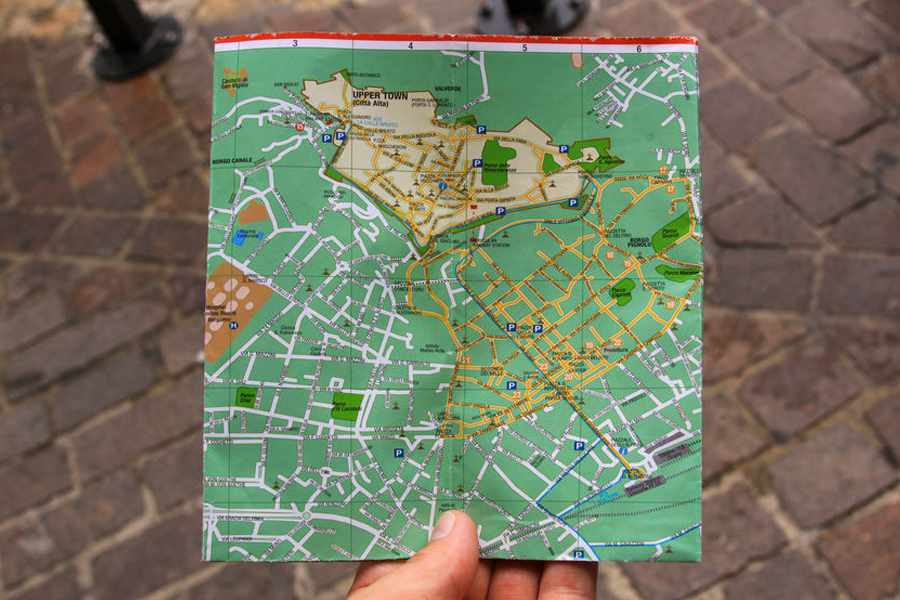
Imagine your feet in damp socks inside your sneakers. You jump over puddles on a busy Italian street. Rain drips off your glasses as you try to read the map your cruise line provided, searching for Mercato Centrale di Livorno—the Livorno Central Market. You’re nervous, but you think of your grandparents arriving in the U.S. 100 years ago. If they could navigate the streets of a foreign country, so can you. Your husband insists he knows the way, but you are skeptical. You just want to get inside, get warm, dry your feet.

It’s the first morning of your 30th-anniversary Mediterranean cruise, and you have arrived at your first stop. You duck into an information center, where a nice woman behind the counter shows you the way to the market.

“Go outside,” she says. “Turn left and there it will be.”

But the streets spread out like crooked wheel spokes. Which left? Your husband says he knows. You follow him and spy a brightly lit shop with an artful display of knit hats. You try on a soft purple one. Only six euros. In the mirror, you look stylish.

You walk on, your head dry and warm, but still no mercato. A pastry shop beckons. Don’t they always? You pull open the glass door and step inside. The man behind the counter shrugs when you ask directions. Frustration grips your forehead.

Imagine a male voice behind you. “Where do you want to go?” he asks. You show him on your map. “Why do you want to go there? It’s nothing to see.” He is dark-haired and handsome. A short pretty brunette at his side smiles at you.

You remember the next item on your list. Perhaps the Modigliani Museum?

“Ah, it is beautiful,” he says, then waves at the rain outside. “Mamma mia!”  He starts to give directions but the brunette interrupts. Clueless, you watch their hands wave left, right, up in the air, until laughing, they turn back to you.

“Come, I will take you there,” he says. “My car is just outside.” You and your husband exchange a glance, imagining the headline: “American Tourists Kidnapped in Italy.”

The man sees your silent exchange. “You can trust me,” he says. “I’m a lawyer.” Everybody laughs and you follow the couple outside to his car, which is indeed parked at the curb. He points at a child-safety seat in the back. “Per i bambini!”

His wife motions you into the back seat with her while your husband climbs in front. “It’s not far,” the Italian man says, putting the tiny car in gear. “Livorno is a very important port in the history of Italy….” His wife rolls her eyes and giggles. She points at your chest.

 “Il nave?”

Sorry, you say, you don’t understand. 

“Boat?” she asks, pointing toward the harbor.

“Si, si!” You both say “Il nave!” You laugh together.

Imagine you are off the boat in more ways than one. Your grandparents left Europe a century ago from a harbor farther north, bound for a better life in New York.     

Yesterday, you flew from New York to Rome in a third of a day, then stepped aboard a luxury liner for a vacation on a ship. Your grandparents’ ocean journey took weeks; they were probably seasick and traveled in steerage. There were no waiters, no violins at dinner. Nobody gave them a map.

But they gave you this: a life in which you sail into a European harbor. Like them, when you arrive at your destination, you seek help from people who barely understand you.

The young lawyer is right. The ride to the museum is short. He drops you off at the entrance and wishes you a nice day. “Grazie,”you say, and you part from the man and his wife using the universal language of nods and smiles.

Inside the museum, you view the work of an artist born in Livorno who lived only 35 years. “Modigliani knew how to soak up influences from everyone,” the curator wrote. “As a sea-faring man, someone who lived in a city with a harbour, …he understood that you can’t live there without encountering people coming into the port from elsewhere….”

That night, you hang your socks to dry in your cruise ship cabin’s tiny bathroom. You imagine the smiling young couple you met today at their home, telling their bambini about the Americans they met in the bakery.


About the Writer:
Linda C. Wisniewski
lives in Bucks County, PA where she volunteers at the historic home of author Pearl S. Buck. Her memoir, Off Kilter, was published in 2008 by Pearlsong Press. Linda’ debut novel, Where the Stork Flies, is forthcoming from Sand Hill Review Press. She blogs about life and connections at www.lindawis.com.